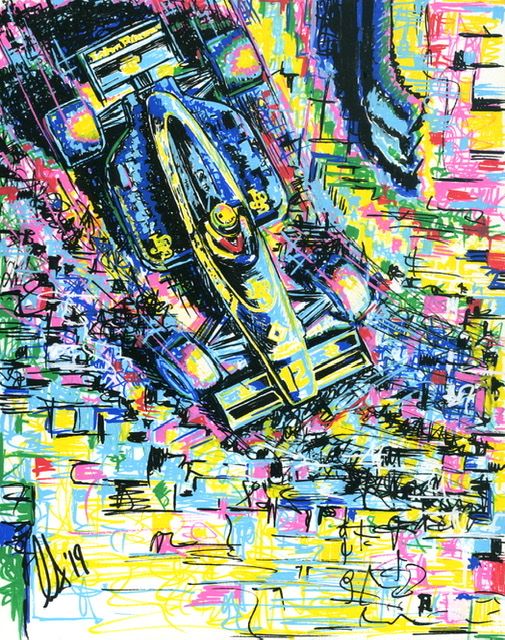
I’ve never been to WeatherTech Raceway Laguna Seca. It’s another one of those California tracks that has always been too far away from where I live to go to. It is the type of track I dreamed of racing at when I dreamed of living the vagabond racer lifestyle.
WeatherTech Raceway Laguna Seca is in Monterrey, CA, five-and-a-half hours north of Long Beach and two-and-a-half hours south of Sonoma Raceway, along the California coast. The track’s website says this about the history of the track and the area:
The Monterey Peninsula’s love affair with world-class racing traces its beginnings to the inaugural running of the Pebble Beach Road Races in 1950. Those sports car events quickly outgrew the public roads of the Del Monte Forest and a beautiful new road racing facility was born on November 9, 1957.
The earliest development of the local area occurred in 1867 with the founding of the nearby Laguna Seca Ranch, which had operated continuously for 140 years with grazing and equestrian uses.
The original Laguna Seca Raceway was built in 1957 at a cost of $1.5 million raised from local businesses and individuals on part of the US Army’s Fort Ord (a maneuver area and field artillery target range) after the nearby Pebble Beach Road Races were abandoned for being too dangerous. In 1974, the property was deeded over to the Monterey County Parks Department. The entire facility is owned by Monterey County.
The first race, held on November 9, 1957, was won by Pete Lovely driving a Ferrari. In the intervening years, the track has hosted USRRC, Can-Am, Trans-Am, Formula 5000, IMSA GT, Champ Car, American Le Mans Series, Grand-Am, Superbike World Championship and MotoGP motorcycle races and the Rolex Monterey Motorsports Reunion.
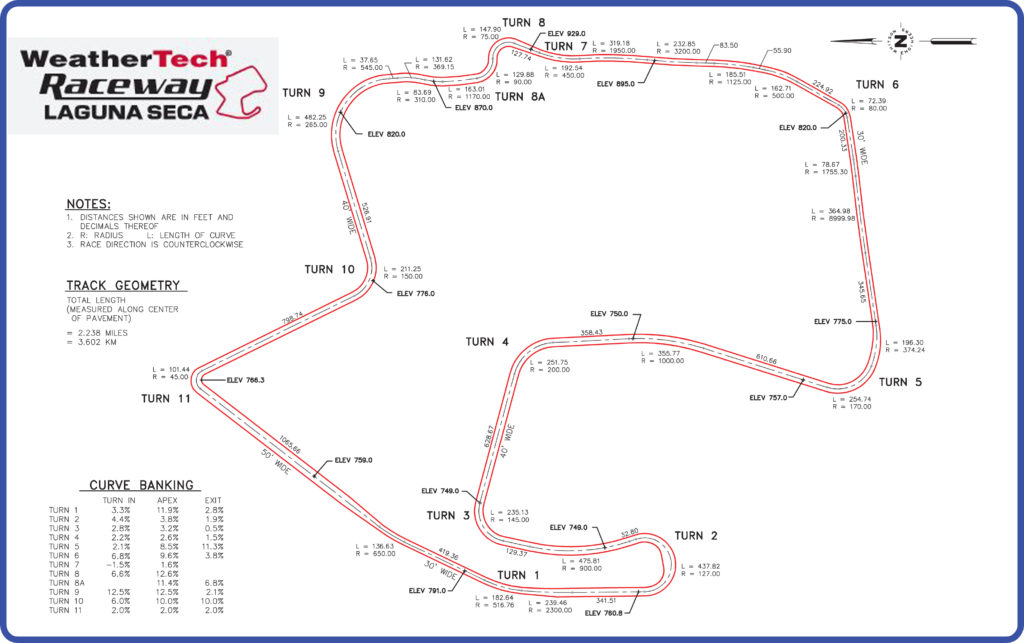
The track itself has undergone significant changes over the past two decades to meet evolving safety homologation requirements. Changes include the addition of the entire infield area in 1988 (present day turns 3, 4 and 5, eliminating the straight that started at present day Turn 2 and ended at present day Turn 5) extending the track from its original 1.9-mile length to its current 2.238-mile length, plus the relocation of pedestrian bridges and embankments, and the expansion of gravel pits for additional runoff.
The original media center was demolished in 2006 and replaced by the Hospitality Pavilion (formerly known as the Red Bull Energy Center), a modern entertainment facility with commanding views of the facility.
Perhaps one of the most famous moments of racing took place at the Corkscrew when Alex Zanardi passed Bryan Herta on the inside of the Corkscrew on the last lap of the 1996 CART race to take the victory.
“The Pass” is one of the most iconic moments in all of motorsports. I watched it live on TV, and from that moment, I wanted to race on the track where my hero, Alex Zanardi, made history. Here’s what it looked like:
Wow! It still gives me chills to watch it.
Here’s a look at the track map:
Next up is race one at WeatherTech Raceway Laguna Seca.